


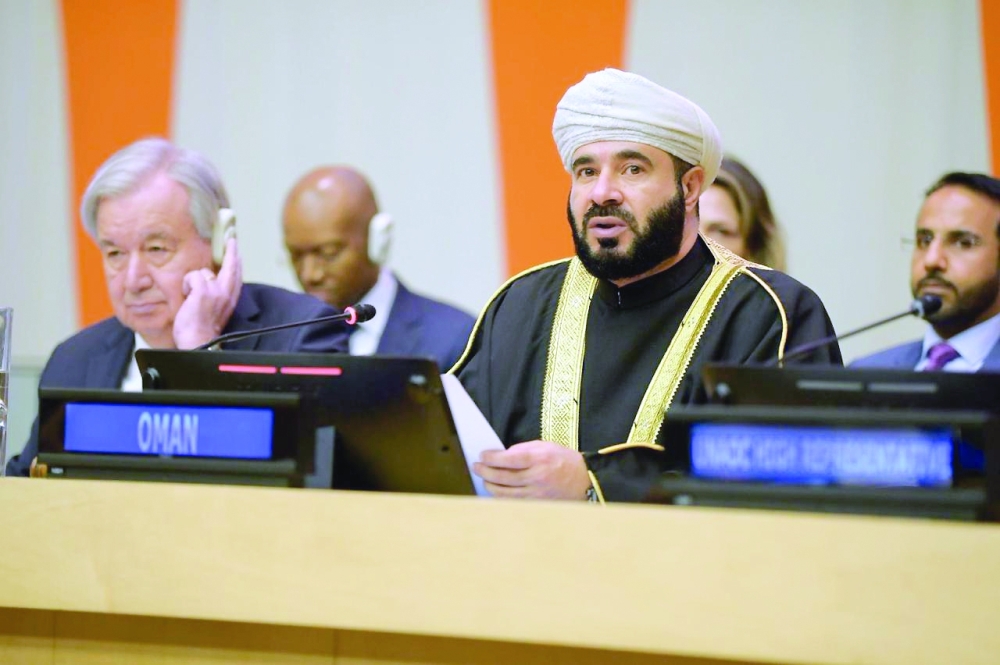





Muscat: Oman unveiled its vision of civilisational coexistence to the UN headquarters in New York on Thursday with the launch of the Muscat Plan of Action, a global framework that places traditional and indigenous leaders at the centre of efforts to counter hate speech and prevent atrocity crimes.
Representatives of traditional and indigenous communities from around the world joined senior UN officials and member state delegations at the launch event, which was jointly organised by Oman’s Permanent Mission to the UN and the UN Alliance of Civilisations.
Dr Mohammed bin Said al Maamari, Minister of Awqaf and Religious Affairs, framed the plan as something deeper than a diplomatic initiative, and as the distillation of decades of Omani lived experience in coexistence, quiet mediation and bridge-building across cultures.
“Real peace is not built on fear, it is built through trust; not through exclusion but through participation,” he told delegates, invoking Hi Majesty Sultan Haitham bin Tarik’s Vision of Oman as a nation whose “message of peace will travel the world.” The central challenge facing the world, Dr Al Maamari said, was not the existence of diverse identities, religions and cultures, but the erosion of shared spaces that allow people to cooperate across those differences.
The Muscat Plan was designed to help rebuild those spaces and to shift the international conversation “from managing differences to building partnerships,” he added.
The UN Secretary-General, Antonio Guterres, inaugurated the launch and said he hoped the plan would resonate in capitals around the world.
“Hate speech is a grave and growing threat to peace and security,” he told delegates, describing it as “a core component in the playbook for virtually every genocide and atrocity crime.” He warned that hate speech was spreading “faster and farther than ever before” and identified artificial intelligence and unregulated digital platforms as the primary accelerants of this trend.
He called on member states to hold technology companies to account and require that user safety is embedded in product design. He flagged the UN’s first Global Dialogue on AI, a two-day event due to take place on July 6 and 7, as offering a key opportunity to advance that agenda.
Beyond the digital domain, Guterres outlined three further pillars for action: the strengthening of local capacities for prevention and mediation; support for dialogue initiatives that help build social cohesion; and the expansion of formal roles for traditional and indigenous leaders in conflict mediation, with institutional backing from political figures.
“You bring crucial knowledge of local realities, plus the respect and trust of your people,” he told the assembled leaders and officials. “Your authority and influence can help ease tensions before they escalate.” The Arab world is home to several communities that fall squarely within the mandate of the framework, groups whose traditional structures mean they are both acutely vulnerable to identity-based violence and natural beneficiaries of the plan’s model of empowerment.
The plan is the product of a global consultative process that was convened by the Network for Religious and Traditional Peacemakers in Muscat. It is modelled in part on earlier localised frameworks, including the Abuja Plan of Action, an African health and development framework established in 2000.
“We believe that persons are larger than hatred and that wisdom is greater than conflict, and that what brings people together is greater than what divides them,” Dr Al Maamari said.
Oman Observer is now on the WhatsApp channel. Click here


